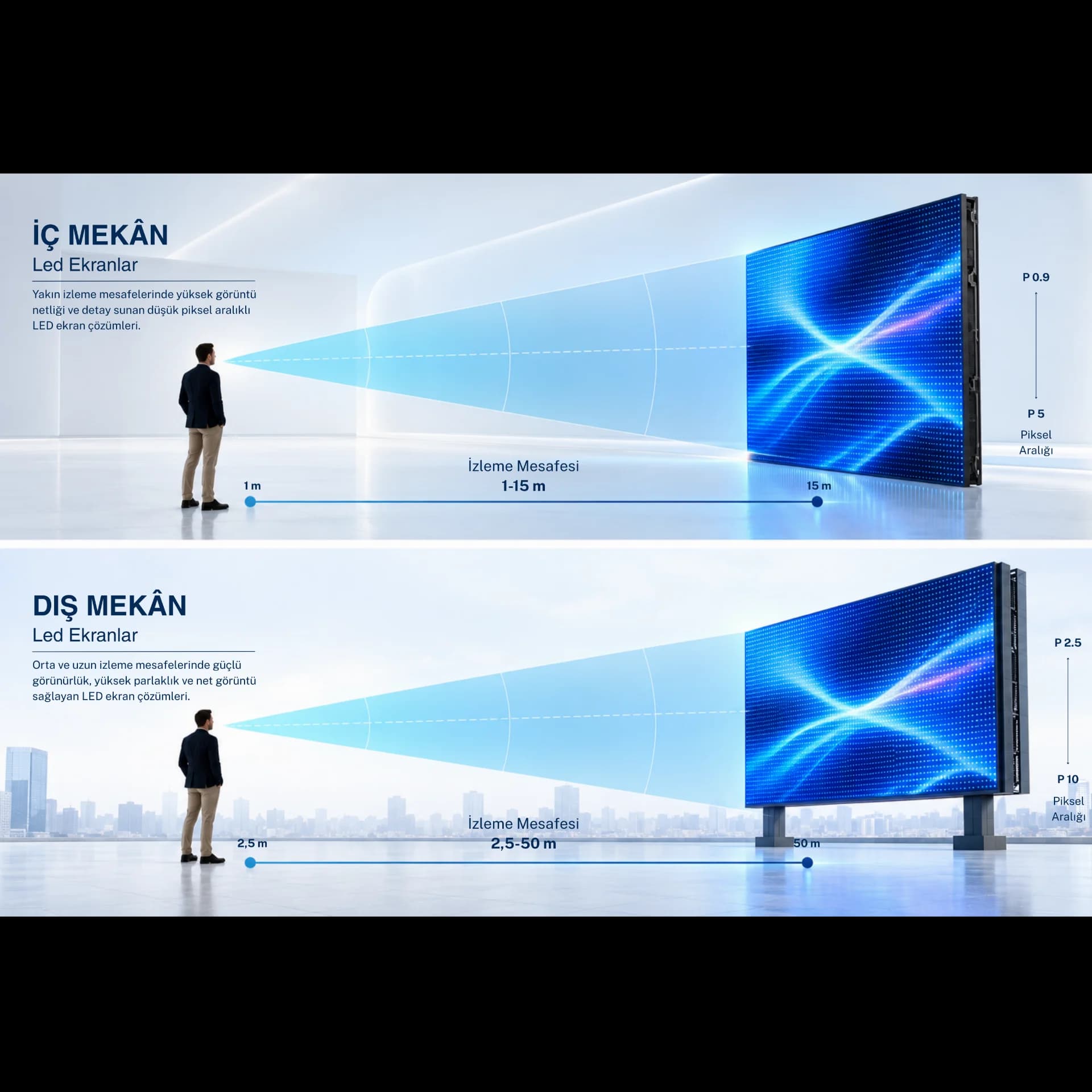
What is pixel pitch, and how does it affect LED display performance? Explore pixel density, viewing distance, and resolution across indoor, outdoor, flexible, rental, and transparent LED displays through real Ledtime projects.
What Is Pixel Pitch?
Pixel pitch is the center-to-center distance between two adjacent pixels on an LED display, measured in millimeters (mm). For example, a P2.5 LED display has a pixel spacing of 2.5 mm. As pixel pitch decreases, more pixels fit within the same display area, allowing higher resolution.
How Does Pixel Pitch Affect Image Quality?
Smaller pixel pitches provide finer image detail, particularly when displays are viewed from short distances. Text, graphics, and detailed visual content can appear sharper. However, image quality also depends on screen dimensions, content resolution, image processing, and viewing conditions.
Which Pixel Pitches Are Used for Indoor and Outdoor LED Displays?
Ledtime Engineering's indoor LED display range includes P1.25, P1.53, P1.86, P2.5, P3, and P4. These models are suitable for retail stores, meeting rooms, corporate environments, and close-range digital display applications.
The outdoor LED display range includes P2, P2.5, P3, P4, P5, P8, and P10. These solutions are used in building facades, digital advertising, stadiums, and public spaces with different viewing requirements.
In addition, Flexible LED, Rental LED, and Transparent LED displays offer various pixel pitch options depending on their structure, geometry, and intended application.
How Do You Choose Pixel Pitch Based on Viewing Distance?
Viewing distance is one of the main considerations when selecting an LED display. A common initial guideline relates pixel pitch in millimeters to approximate viewing distance in meters. For example, P2.5 can be associated with approximately 2.5 meters, while P5 can be associated with approximately 5 meters.
These values are not strict limits. The appropriate distance depends on content detail, screen dimensions, and viewing expectations.
Is a Smaller Pixel Pitch Always Better?
Not necessarily. A smaller pixel pitch provides more pixels within the same screen area, but this level of density may not be necessary for every application. For large displays viewed from greater distances, additional pixels may offer limited perceptible improvement.
Therefore, choosing the right pixel pitch requires balancing image performance, screen size, viewing distance, and project budget.
Which Pixel Pitches Have Been Used in Ledtime Projects?
Ledtime Engineering's completed projects demonstrate how different pixel pitches are applied to specific environments.
At Tudors Vadi Istanbul, a P1.86 indoor LED display represents a close-range retail application. The 23 m² P2.5 LED display at GIZIA Nişantaşı demonstrates the relationship between screen scale and resolution.
The Nike İstinyePark P4 Flexible LED installation illustrates how LED technology can adapt to curved architectural forms, while the Nike Istanbul Airport P3.9 Transparent LED display highlights the use of transparent digital surfaces.
For large-scale installations, the P5 and P10 outdoor LED displays at Tizi Ouzou Stadium demonstrate different pixel pitch solutions for extensive viewing areas.
What Should Be Considered When Selecting an LED Display?
The appropriate pixel pitch should be determined by evaluating viewing distance, screen dimensions, total resolution, ambient lighting, intended application, and installation requirements. Drawing on its experience across different sectors, Ledtime Engineering develops LED display solutions tailored to the technical requirements of each project.